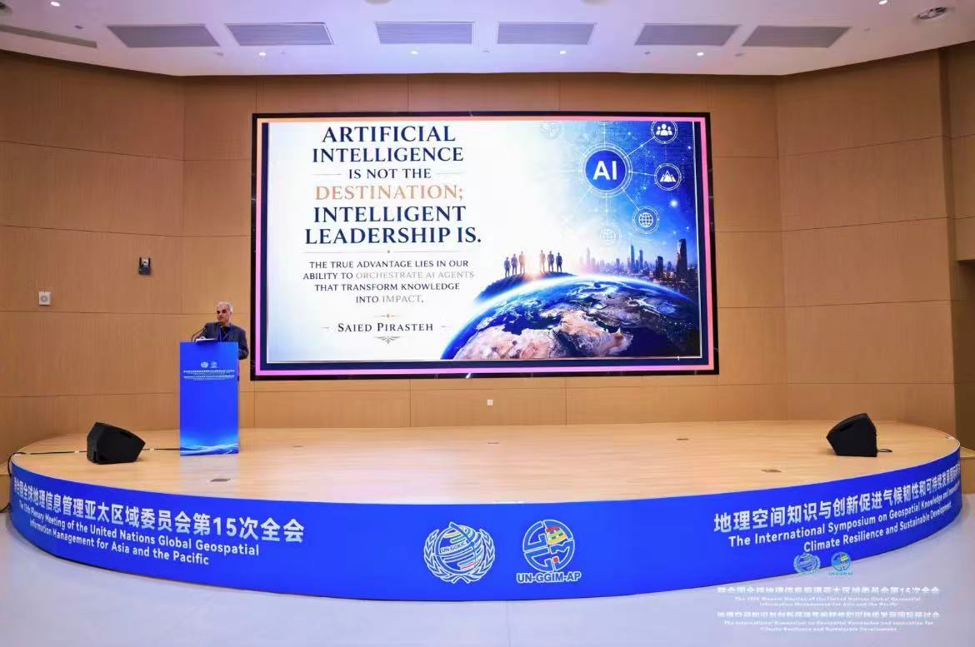
Sanya, Hainan, China — September 2026
Professor Saeid Pirasteh, Professor of GeoAI and Environmental Disasters and Sustainability and Associate Dean of the Institute of Artificial Intelligence at Shaoxing University, delivered an invited keynote address entitled “The Role of GeoAI in Ethical Governance and Global Sustainability: Standardization Considerations” at the International Symposium on Geospatial Knowledge and Innovation for Climate Resilience and Sustainable Development, held in Sanya, Hainan, China, from 21–24 September 2026.
The symposium was organized in conjunction with the 15th Plenary Meeting of the United Nations Global Geospatial Information Management for Asia and the Pacific (UN-GGIM-AP) and brought together international organizations, policymakers, researchers, and geospatial experts to explore the role of geospatial innovation, artificial intelligence, and digital technologies in advancing climate resilience, sustainable development, and responsible geospatial governance.
In his keynote, Professor Pirasteh highlighted GeoAI's evolution from human-prompted analytical systems to context-aware, agentic, and proactive intelligence. He introduced GeoAI Plus (GeoAI+) as a distributed cognitive ecosystem that integrates Earth observation, UAVs, sensors, GIS, IoT, knowledge systems, and AI models to support continuous sensing, reasoning, and decision intelligence.
Emphasizing the future direction of artificial intelligence, Professor Pirasteh stated: “Artificial Intelligence is not the destination; intelligent leadership is.” He highlighted that the advancement of AI requires not only technological innovation but also ethical governance, international standards, transparency, and accountability.
A key theme of his presentation was promptless AI, where intelligent systems can receive information directly from sensors, databases, and operational environments to initiate appropriate workflows without explicit human prompts. He emphasized that while such systems offer significant opportunities for disaster management, environmental monitoring, climate resilience, and sustainable development, they also introduce important governance questions regarding objectives, control, and accountability.
Professor Pirasteh concluded by calling for global collaboration to develop trustworthy and responsible GeoAI ecosystems that can support a sustainable, resilient, and intelligent future.